2026 Best Cargo Golf Carts for Global Buyers?

Time:2026-10-15 Author:Oliver
0%

Choosing the right Cargo Golf Carts in 2026 requires more than comparing prices and advertised load ratings. Global buyers must examine real working conditions, including warehouse floors, farm tracks, resort paths, and uneven construction sites. A cart carrying tools through rain needs different protection from one moving sealed boxes indoors. Small details matter.

This guide evaluates practical models through capacity, range, charging time, braking performance, turning space, and service support. It also considers electric systems, battery choices, tire design, suspension comfort, and weather resistance. Experience from daily operations shows that a strong motor alone does not guarantee useful performance. A cart may climb a steep ramp but consume energy quickly. That weakness can disrupt a full workday.

Reliable purchasing also requires careful verification. Buyers should request technical documents, warranty terms, replacement-part availability, and clear testing information. Local road requirements and workplace safety standards must be checked before any purchase. These rules vary across regions. A vehicle suitable for private property may not be approved for public roads.

Not every advertised specification tells the full story. Some manufacturers provide ideal range figures from controlled tests. Actual distance may fall with heavy cargo, cold weather, hills, or frequent stops. That deserves honest attention. This 2026 overview compares leading Cargo Golf Carts with a practical, evidence-based approach. It highlights dependable strengths, possible limitations, and questions buyers should ask before committing to an international order.
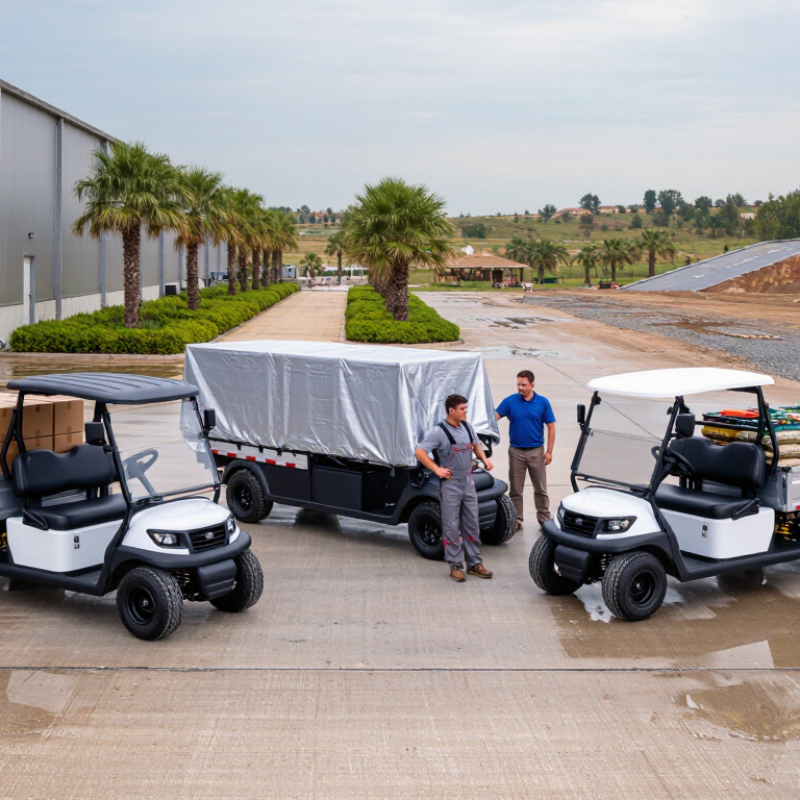
2026 Best Cargo Golf Carts for Global Buyers?

Cargo Golf Cart Types: 2–6 Seats, 500–1,500 lb Payload Classes

2026 Best Cargo Golf Carts for Global Buyers?

Cargo golf carts now serve resorts, campuses, warehouses, farms, and maintenance teams. The right choice depends on payload, seating, terrain, and daily driving distance. A two-seat cart usually preserves more bed space. It often suits tools, parcels, and light service equipment under 500 pounds.

Three- and four-seat models improve crew movement but reduce usable cargo area. Six-seat carts carry more people, yet their passenger weight directly reduces cargo capacity. This detail is often missed. The 500–1,500-pound payload classes should include passengers, batteries, accessories, and cargo. Buyers should confirm the manufacturer’s definition before comparing specifications. ANSI/ITSDF B56.8 guidance emphasizes safe design for personnel and burden carriers, while OSHA material-handling guidance supports careful load control and stability checks.

Payload is not the whole story. Grand View Research’s electric golf cart market analysis identifies utility and commercial applications as important growth areas. MarketsandMarkets also reports broader adoption of electric off-highway vehicles, driven by lower operating noise and maintenance needs. These reports indicate demand, not proof of a specific cart’s capacity. Real-world testing still matters. Check braking distance, turning radius, ground clearance, axle ratings, and battery performance on slopes. A 1,500-pound rating may become impractical on wet grass or uneven gravel. Sometimes, the smaller cart works better. Ask for independent test records, clear warranty terms, and replacement-part availability in the destination country.

Power Systems Compared: 48V Lead-Acid Versus Lithium-Ion Batteries

For global buyers, a 48V cargo golf cart should be judged by usable energy, not battery voltage alone. A 48V, 200Ah pack stores about 9.6kWh nominally. Lead-acid systems usually provide only 50% usable capacity to protect battery life. Lithium-ion systems commonly allow 80–90%, according to battery engineering guidance from the U.S. Department of Energy. That difference can support longer delivery routes with fewer recharge stops.

Weight also changes handling. A comparable lithium pack may remove more than 100 kilograms from the cart, improving acceleration, braking, and payload capacity. BloombergNEF’s 2024 Battery Price Survey reported an average lithium-ion pack price of 115 dollars per kWh, a 20% annual decline. However, golf-cart packs can cost more because they require protective electronics, rugged cases, and certified charging equipment. The market figure is useful, but not a final quotation.

Lead-acid batteries remain practical where purchase price matters most. They tolerate familiar maintenance routines, yet require ventilation, watering, and careful charging. Battery Council International reports that lead batteries have a recycling rate above 99% in the United States. Lithium packs usually need less daily attention and offer longer cycle potential, but cold-weather performance and replacement controls deserve inspection. A spreadsheet can mislead. Real costs depend on route length, payload, charging access, and technician skill. Testing one loaded cart over a full workday is still wiser than trusting a brochure.

2026 Best Cargo Golf Carts for Global Buyers? – Power Systems Compared: 48V Lead-Acid Versus Lithium-Ion Batteries

Comparison Dimension 48V Flooded Lead-Acid 48V Lithium-Ion
(Typically LiFePO₄)
Buyer Takeaway for Cargo Use
Typical battery configuration Eight 6V deep-cycle batteries, commonly rated at 170–225 Ah One 48V battery pack, commonly rated at 100–150 Ah Confirm the cart controller, charger, connectors and battery enclosure before ordering.
Nominal stored energy Approximately 8.2–10.8 kWh Approximately 4.8–7.2 kWh Nominal kWh alone does not determine range; usable depth of discharge and load are equally important.
Recommended usable depth of discharge About 50% for good service life About 80–90%, depending on the battery-management system and manufacturer limits Lithium usually provides more usable energy from a smaller and lighter pack.
Typical battery-pack weight Approximately 450–600 lb (205–272 kg) Approximately 110–180 lb (50–82 kg) The lower lithium weight can increase available payload or reduce energy consumption.
Practical range per charge Approximately 25–45 miles (40–72 km) on level routes with moderate cargo Approximately 30–55 miles (48–89 km) with a comparable usable-energy setup Actual range changes substantially with payload, hills, speed, tire pressure, temperature and road surface.
Typical recharge time Approximately 8–12 hours with a suitable automatic charger Approximately 4–8 hours, depending on charger output and battery capacity Lithium is generally better for multi-shift operations requiring short turnaround times.
Expected cycle life Approximately 500–800 cycles when properly charged and maintained Approximately 2,000–4,000 cycles for quality LiFePO₄ systems operated within specified limits Cycle life depends on temperature, discharge depth, charging practice and storage conditions.
Routine maintenance Water-level checks, terminal cleaning, corrosion inspection and equalization charging Normally no watering; inspect cables, enclosure, charger and battery-management-system alerts Lithium reduces scheduled maintenance, especially in dusty or labor-intensive sites.
Charging-location requirements Ventilated charging area recommended because charging can release hydrogen gas Normal ventilation is generally sufficient, but charging must follow the battery system’s safety instructions For indoor warehouses, verify local electrical, fire and ventilation requirements.
Performance near low state of charge Voltage sag becomes noticeable under heavy cargo or uphill loads More consistent voltage and acceleration until the battery-management system limits output Lithium is useful where stable torque is important, but the low-battery warning strategy must be understood.
Cold-weather operation Capacity and cranking performance decline in cold conditions Charging below 0°C (32°F) may be restricted unless the pack has low-temperature protection or heating Global buyers should specify the operating temperature range and low-temperature charging protection.
Cargo-payload effect High battery weight can consume a substantial portion of the vehicle’s payload allowance Lower battery weight leaves more capacity for tools, parcels or materials Always calculate payload as vehicle, passengers, battery, accessories and cargo combined.
Purchase-cost profile Lower initial battery cost; replacement may be required more frequently Higher initial cost; longer service life and lower maintenance can improve total cost of ownership Compare total cost over the planned operating years, not only the initial purchase price.
Best-fit operating profile Low-utilization fleets, simple service environments and buyers prioritizing low upfront cost Frequent daily use, indoor logistics, higher payload requirements and operations needing fast turnaround The best system depends on duty cycle, climate, service capability, charging access and budget.

Note: Values are typical engineering ranges for 48V utility and cargo golf-cart applications. Actual specifications vary by battery capacity, vehicle design, terrain, payload, charger settings, ambient temperature and operating practices. Confirm the vehicle’s rated payload, battery certification, charger compatibility and local safety requirements before purchase.

Global Compliance Guide: UL 2202, CE, EMC, and UN 38.3 Requirements

2026 Best Cargo Golf Carts for Global Buyers?

Global buyers should treat compliance as a design requirement, not a final paperwork task. UL 2202 may apply to charging equipment, depending on its construction and market use. It should not automatically be presented as approval for the entire cargo cart. Ask for the exact standard scope, test report, and certificate holder.

For European sales, CE marking reflects compliance with applicable requirements, including machinery, low-voltage, battery, and electromagnetic compatibility rules. EMC testing checks whether the cart creates harmful interference or fails in a noisy electrical environment. Request the test setup, product model, voltage range, and technical file. Documents with unclear model numbers deserve caution. I have seen compliance claims weaken when the charger changed but the report did not.

Tips: Match every certificate to the final cart configuration. Verify battery chemistry, charger ratings, wiring, and emergency controls. For lithium batteries, UN 38.3 testing supports transportation compliance, but it is not a complete product safety certification. Keep the test summary, packing instructions, and shipment records together. Local import rules may request additional evidence. A practical pre-shipment inspection should include braking, load stability, battery enclosure strength, and charging temperature. Small details matter.

2026 Best Cargo Golf Carts for Global Buyers?

Global Compliance Guide: UL 2202, CE, EMC, and UN 38.3 Requirements

UL 2202

Check whether the vehicle charging equipment falls within the applicable scope and edition of UL 2202 or another relevant product-safety standard.

CE and EMC

CE marking requires the applicable EU conformity route, technical documentation, and declaration of conformity. EMC assessment generally covers emissions and immunity.

UN 38.3

Lithium cells and batteries offered for transport must be evaluated against the eight UN 38.3 test categories shown in the chart, when applicable.

The chart presents the recognized UN 38.3 test sequence: T.1 altitude simulation, T.2 thermal test, T.3 vibration, T.4 shock, T.5 external short circuit, T.6 impact or crush, T.7 overcharge, and T.8 forced discharge. Final requirements depend on vehicle design, battery chemistry, destination market, transport mode, and the applicable legal edition.

2026 Buyer Scorecard: Range, Payload, Gradeability, and Total Cost

2026 Best Cargo Golf Carts for Global Buyers?

Range is conditional. A cargo cart advertised with long range may travel less on hills, rough paths, or cold mornings. Test it loaded, not empty. Record distance with the intended payload, tire pressure, and stop-and-go driving. Lithium batteries often reduce routine maintenance, but replacement costs can be significant. Lead-acid systems may cost less initially, yet charging and watering require more labor.

Payload should match real work, not a brochure number. Weigh tools, materials, passengers, and containers together. Leave a safety margin for uneven ground. A cart carrying 500 kilograms on level pavement may feel unstable on a wet incline. Gradeability also depends on motor torque, controller settings, tire grip, and battery condition. Ask for measured performance, not only a maximum angle. Small details matter.

Total cost includes freight, import charges, charger compatibility, tires, batteries, service access, and downtime. Local parts availability can matter more than a low purchase price. I have seen buyers focus on range and overlook braking performance after repeated downhill runs. That is an expensive lesson. A spreadsheet can still lie when maintenance hours are missing. Compare three-year ownership costs using your terrain, climate, electricity price, and daily workload. Then question the assumptions.

Fleet Selection by Use: Farms, Warehouses, Resorts, Ports, and Municipalities

2026 Best Cargo Golf Carts for Global Buyers?

Fleet Selection by Use: Farms, Warehouses, Resorts, Ports, and Municipalities

In 2026, the best cargo golf cart is not always the fastest model. It is the vehicle that matches daily routes, payloads, terrain, and charging access. Farms need ground clearance, durable tires, and a cargo bed that handles feed bags, tools, and muddy crates. A low step and simple controls reduce strain during long workdays. Weather protection also matters when workers move between fields.

Warehouses usually need tight turning, predictable braking, and narrow dimensions. A compact cart can move pallets through crowded aisles without disrupting forklifts. Resorts may value quiet operation, passenger comfort, and enclosed storage for towels, maintenance supplies, or luggage.

Ports require stronger frames, corrosion-resistant components, and visible lighting for large outdoor areas. Municipal fleets benefit from lockable cargo space, easy servicing, and dependable range during inspections or park maintenance.

Ask for real operating data, not only advertised capacity. Test the cart on ramps, loose gravel, wet pavement, and repeated stop-start routes. Check battery charging time, replacement access, and technician training. A cart rated for heavy cargo may perform poorly on steep ground. That is an easy mistake. Fleet managers should record payload weights, daily distance, and seasonal temperature changes before ordering. No cart fits every fleet. Even a careful selection may need adjustment after several weeks of field use.

FAQS

What should buyers compare in a 48V cargo cart?

Compare usable energy, not voltage alone. A 48V, 200Ah battery stores about 9.6kWh nominally. Lead-acid batteries often provide around 50% usable capacity. Lithium-ion batteries commonly provide 80–90%. Actual range still depends on cargo, terrain, and driving habits.

How does battery weight affect cart performance?

A similar lithium-ion pack may reduce weight by over 100 kilograms. This can improve acceleration, braking, and payload capacity. The change is noticeable on ramps. Weight estimates still need verification.

Which battery type usually requires more maintenance?

Lead-acid batteries require ventilation, watering, and careful charging. Lithium-ion batteries usually need less daily attention. However, they require protective electronics and suitable charging equipment. Lower maintenance does not mean zero inspection.

Is lithium-ion always the cheaper long-term choice?

Not always. Lithium-ion packs may cost more initially. Protective cases, control electronics, and certified chargers increase the purchase price. Long cycle life and lower maintenance may improve total cost. A spreadsheet can mislead.

Which cart features suit farm operations?

Farms often need high ground clearance, durable tires, and a practical cargo bed. The cart should carry feed bags, tools, and muddy crates. A low step reduces daily strain. Weather protection helps during field work.

What should warehouses check before choosing a cargo cart?

Check turning space, braking behavior, and overall width. Compact carts can move through crowded aisles more safely. Test them near stored goods and forklift routes. Tight spaces expose weaknesses quickly.

What features matter for resorts, ports, and municipal fleets?

Resorts may prefer quiet operation, comfortable seating, and enclosed storage. Ports need strong frames, corrosion-resistant parts, and visible lighting. Municipal fleets benefit from lockable cargo areas and simple servicing. One design rarely fits every workplace.

How should buyers test a cart before ordering?

Test one loaded cart during a complete workday. Use ramps, loose gravel, wet pavement, and repeated stop-start routes. Record payload weight, distance, charging time, and temperature. Real use can challenge the brochure. Adjustments may be necessary later.

Conclusion

The 2026 guide to Cargo Golf Carts helps global buyers compare practical utility vehicles by seat capacity, payload, powertrain, compliance, and operating cost. Available configurations range from compact two-seat models to six-seat platforms, with typical payload classes from 500 to 1,500 pounds. Buyers can evaluate 48V lead-acid systems for lower initial cost and straightforward servicing, or lithium-ion batteries for reduced weight, faster charging, longer cycle life, and improved energy efficiency.

A buyer scorecard should measure usable range, payload capacity, gradeability, charging time, maintenance needs, safety features, and total cost of ownership. Compliance planning is equally important: depending on the destination and application, purchasers may need documentation related to UL 2202, CE marking, EMC performance, and UN 38.3 testing for lithium battery transportation. Farms may prioritize traction and cargo space, warehouses maneuverability and uptime, resorts passenger flexibility, ports durability and payload, and municipalities safety, serviceability, and long-term fleet value.


Oliver

Oliver

Oliver is a seasoned marketing professional with a wealth of expertise in driving brand awareness and engagement. With a deep understanding of our company's product offerings, he consistently delivers high-quality content that enriches our professional blog. His insights not only shed light on......