Choosing among China’s leading battery golf cart manufacturers takes more than comparing prices or polished product photos. A cart may look similar on a showroom floor, yet battery chemistry, usable capacity, charging time, and thermal management can shape its daily performance. Range matters. So does service.
Battery scientist Dr. Shirley Meng’s work offers a useful principle, paraphrased here: battery performance should be judged by the complete system and its real-world use, not by a single specification. That perspective helps frame this guide to China’s top 10 Battery Golf manufacturers. It compares makers through practical signals, including product range, battery options, customization, quality processes, warranty clarity, and export support. These factors do not guarantee a perfect purchase. They help buyers ask better questions.
Look closely at the details. Can the supplier explain the battery’s rated capacity and expected operating range? Are charger specifications, replacement parts, and after-sales contacts clearly documented? A vague answer deserves a follow-up. Small details count.
This list is a starting point, not a final verdict. Manufacturer capabilities and product specifications can change, and a strong factory profile does not replace sample testing or reference checks. That is easy to overlook. The best-fit supplier will depend on terrain, passenger load, climate, maintenance resources, and local usage patterns. Some comparisons may remain imperfect when public information is limited; that uncertainty should be stated, not hidden. Read on for a grounded overview of manufacturers worth evaluating and the evidence buyers can request before making a decision.
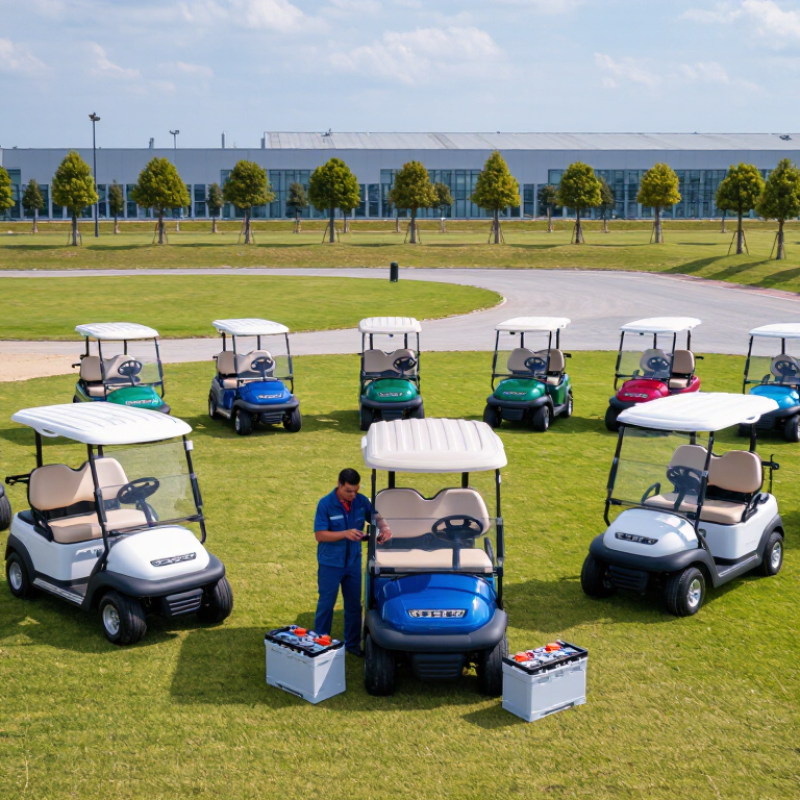
China’s battery golf cart manufacturing industry draws on a broad ecosystem of battery, motor, controller, and metalworking suppliers. Many producers handle vehicle assembly and customization, including seat layouts, cargo beds, and enclosed cabins. Factory capability varies, though. A clean showroom sample does not prove that a cart can handle daily use on wet paths or steep course lanes.
The Ministry of Industry and Information Technology reported that China’s lithium-ion battery output exceeded 940 GWh in 2023, up 25% year on year. It also reported battery-product exports worth 457.4 billion yuan. These figures describe the wider battery sector, not golf-cart production, but they show the scale of the upstream supply base. For buyers, pack consistency, motor matching, and after-sales parts availability still need direct verification.
Tips: Ask for loaded-range and hill-climb test results, not just advertised figures. Check how the cart behaves with passengers, a full battery, and a small incline. Request the battery specification and a written spare-parts lead time. Small details matter. Test conditions can differ, and published range figures may feel optimistic in real use.
A credible ranking should reward verified performance, not polished brochures. For Chinese battery golf cart manufacturers, compare production consistency, battery sourcing, chassis durability, charging systems, warranty terms, and parts availability. Ask for test records showing range with a stated passenger load, route gradient, temperature, and tire pressure. These details matter: a cart covering flat pavement may perform very differently on a hilly resort path.
Numbers matter.
Battery claims deserve particular scrutiny. BloombergNEF’s 2023 Battery Price Survey reported an average lithium-ion pack price of US$139 per kilowatt-hour, down 14% year over year. This is a broad market benchmark, not a golf-cart battery price; use it to understand cost trends, not to judge a supplier alone.
Score battery capacity, cycle-life evidence, charging time, and protection features separately. Then assess quality-control records, manufacturing capacity, export experience, and documented after-sales response. Request sample inspection reports and replacement-part lead times.
The International Energy Agency’s Global EV Outlook 2024 also describes falling battery costs, but automotive data cannot prove cart-level durability. Keep that distinction clear.
A weighted scorecard can improve consistency, yet supplier disclosures are uneven.
That is a real weakness. State missing evidence openly, and avoid treating a high score as a guarantee.
China’s battery golf cart manufacturers serve different needs, from compact resort vehicles to carts built for larger courses. The ten profiles are best compared by engineering focus, production scale, and after-sales support, not by brochure claims alone. Details matter. Ask whether a maker builds the frame, integrates the battery system, or relies on outside suppliers.
Some manufacturers emphasize lithium battery options, while others continue to offer lead-acid configurations for buyers weighing upfront cost against charging time and service life. Look for clear specifications on motor output, range, load capacity, and charging duration. A useful profile also explains practical details, such as ground clearance on uneven paths and access to replacement parts. Small design choices can shape daily maintenance.
Export experience, customization, and quality checks vary across factories. Request inspection records, warranty terms, and sample-cart performance data before comparing quotations. A neat finish is reassuring, but it cannot prove durability by itself. I would also check how the cart handles repeated stops, wet turf, and a full passenger load. Public information may not reveal every production difference, so some comparisons remain imperfect.
China’s battery golf cart manufacturers serve golf courses, resorts, campuses, and residential communities. Common products include two- and four-seat carts, utility vehicles with cargo beds, and sightseeing models. Enclosed cabins, higher ground clearance, and extra storage can suit specific routes. Check payload, turning radius, braking, and local parts support, not just advertised range. Small details matter.
Battery options commonly include lead-acid and lithium-ion packs, with lithium iron phosphate used in many newer models. Lead-acid batteries can cost less upfront, but usually need more routine maintenance. Lithium packs are lighter and may charge faster, while a battery management system helps monitor temperature and charging. Real-world range still depends on passenger load, hills, speed, and weather. Ask for test data under conditions similar to your route. Export reach varies by manufacturer, and certifications, charger compatibility, and after-sales coverage should be verified for each destination. Specs can look neat on paper. They may not tell the whole story.
Tips: Request the battery capacity, charger details, warranty terms, and replacement-part lead times in writing. If possible, test a loaded cart on your actual terrain; a short demo can reveal practical weaknesses.
Golf carts are commonly designed around 36 V and 48 V battery systems, with 72 V systems also available. Both lead-acid and lithium-ion packs are offered in different configurations; compatibility depends on the vehicle’s electrical system.
The bars show nominal system-voltage options, not manufacturer rankings, sales figures, or market shares.
Comparing battery golf cart manufacturers takes more than checking advertised range. Ask for usable battery capacity, chemistry, charger specifications, and a written warranty. Then compare those details against your route, passenger load, and charging schedule. A cart carrying four people up steep paths needs different capacity from one crossing flat pavement. Ask for range test conditions, too. “Up to” figures may assume light loads and ideal surfaces.
Battery prices offer useful context, but not a direct cart price. BloombergNEF’s 2024 battery price survey reported an average lithium-ion pack price of $115 per kilowatt-hour, 20% lower than in 2023. That figure covers broad battery markets, not golf cart packs. The International Energy Agency’s Global EV Outlook 2024 also reported falling battery prices, while noting that chemistry and supply conditions affect costs. Compare complete ownership costs, including replacement packs, maintenance, and charger compatibility. Check the warranty. Confirm its coverage period and cycle limits in writing. A polished brochure may leave out service response times, spare-part availability, or performance in cold weather. Test the cart on your actual terrain where possible. Specs can still disappoint.
| China Top 10 Battery Golf Cart Manufacturers - Factors to Consider When Comparing Manufacturers | ||
|---|---|---|
| Comparison Factor | What to Compare | Useful Evidence to Request |
| Battery Chemistry | Compare lead-acid and lithium-ion options. Lead-acid batteries generally require periodic maintenance; lithium-ion systems typically use a battery management system (BMS) to monitor and protect the pack. | Battery datasheet stating chemistry, maintenance requirements, operating limits, and whether a BMS is included. |
| Voltage and Cart Compatibility | Confirm the pack’s nominal voltage matches the cart’s electrical system. Golf carts commonly use 36 V or 48 V systems, but the required configuration depends on the vehicle. | Cart wiring diagram, battery configuration, controller specifications, and written confirmation of compatibility. |
| Capacity and Usable Energy | Compare amp-hour (Ah) capacity alongside voltage. Approximate energy in watt-hours (Wh) can be calculated as nominal volts × amp-hours; usable energy may be lower than the nominal figure. | Rated voltage and capacity, the test conditions used for the rating, and any stated usable-capacity limit. |
| Range Claims | Treat advertised range as an estimate. Actual distance per charge varies with passenger and cargo load, terrain, speed, temperature, tire condition, and driving style. | Range-test method, vehicle configuration, test route and conditions, and the assumptions behind the quoted figure. |
| Cycle-Life Rating | Compare cycle-life figures only when the depth of discharge, temperature, charge method, and end-of-life definition are comparable. A cycle-life figure is not a guarantee of a fixed service duration. | Test report or datasheet defining the test conditions and the remaining-capacity threshold used at end of life. |
| Charger and Charging Time | Verify that the charger’s voltage, charging profile, connector, and current are suitable for the battery chemistry and pack configuration. Charging time depends on charger output and the battery’s state of charge. | Charger specifications, charging instructions, connector details, and guidance for storage or extended periods without use. |
| Safety and Compliance | Check which safety and transport requirements apply to the intended destination and use. Requirements vary by market, battery type, and shipping method. | Applicable test reports, declarations, and transport documentation. Confirm that documents cover the specific battery model being offered. |
| Warranty Terms | Compare warranty duration, covered components, capacity-retention terms, exclusions, and the process for making a claim. Warranty coverage can differ by product and market. | Written warranty document identifying the covered model, start date, claim procedure, and any required maintenance or operating conditions. |
| Customization and Integration | Assess whether the supplier can accommodate required dimensions, terminals, connectors, mounting arrangements, display or communication functions, and vehicle-specific integration. | Dimensioned drawings, interface specifications, sample or prototype evaluation, and a documented approval process for design changes. |
| Quality Control and After-Sales Support | Compare inspection and traceability practices, spare-parts availability, technical support, and procedures for handling defects or service issues. | Quality-control process description, sample inspection records, product traceability details, support contacts, and service response arrangements. |
Common options include two- and four-seat carts, cargo-bed utility vehicles, and sightseeing models. Some have enclosed cabins or extra storage.
Ask for the battery type, capacity, charger specifications, warranty terms, and replacement-part lead times. Get the details in writing.
Lead-acid packs often cost less upfront but need more routine maintenance. Lithium packs are lighter and may charge faster.
Treat them as estimates. Passenger load, hills, speed, and weather can change real-world range.
Test it with passengers on terrain like your route. Include a small incline or wet path if those conditions are common.
Check payload, turning radius, braking, and ground clearance. A short drive may reveal issues that a showroom sample cannot.
The wider battery supply base is substantial. In 2023, national lithium-ion battery output exceeded 940 GWh, but that figure does not measure golf-cart production.
Export reach and after-sales coverage vary by manufacturer. Confirm local support and written parts delivery estimates. Paper specifications can look reassuring, but they may not tell the whole story.
China’s Battery Golf cart manufacturing industry has grown through advances in electric vehicle production, battery systems, and export capabilities. This overview explains how manufacturers are assessed, including factors such as product quality, production capacity, technical development, customer support, and experience serving domestic and overseas markets. It also introduces ten leading manufacturers without focusing on brand promotion.
The profiles compare key vehicle types, battery options, design features, and market reach. Readers can consider differences in range, charging time, durability, customization, maintenance, and overall value when evaluating suppliers. By understanding these factors, buyers can make a more informed choice for golf courses, resorts, residential communities, and other suitable applications, while matching a Battery Golf cart to their practical needs and operating conditions.

Zhigao